Data · Insights · Decisions

We turn business data into decisions worth trusting.

Glonex Technologies International is a Qatar-based consultancy delivering Approved Vendor List (AVL) governance, analytics, business intelligence, process re-engineering, and applied AI to oil and gas, industrial, utilities, infrastructure and EPC clients across the region.

What we do

Five services. One coherent practice

Every service is led by senior consultants with twenty to thirty years of national and international experience in oil and gas and other industries. There are no junior hand-offs: the same practitioners you meet at scoping lead the delivery.


Service 01 · Foundation

Analytics & Reporting

Turning raw, scattered business data into reliable, agreed-upon numbers.

Analytics & Reporting is the foundation of every other service we offer. It is the discipline of taking the messy, inconsistent, scattered data produced by a business and turning it into reliable, structured information the organisation can trust and act on. We cleanse and validate inputs, define what each number means, and produce reporting that operators, managers, and executives can all stand behind.

Most organisations have plenty of data. What they lack is data they trust. Sales numbers in one system don't match sales numbers in another; three departments report the same metric three different ways; reporting becomes an argument about whose number is right instead of a conversation about what to do next. Our work is to end that argument — establishing the single source of truth from which everything else can be built.

  • One definition, owned by everyone — the argument about whose number is right stops permanently.
  • Built once, from a governed source — no more three different figures for the same KPI.
  • The foundation every other service requires — BI, AI, and dashboards all fail on dirty data.
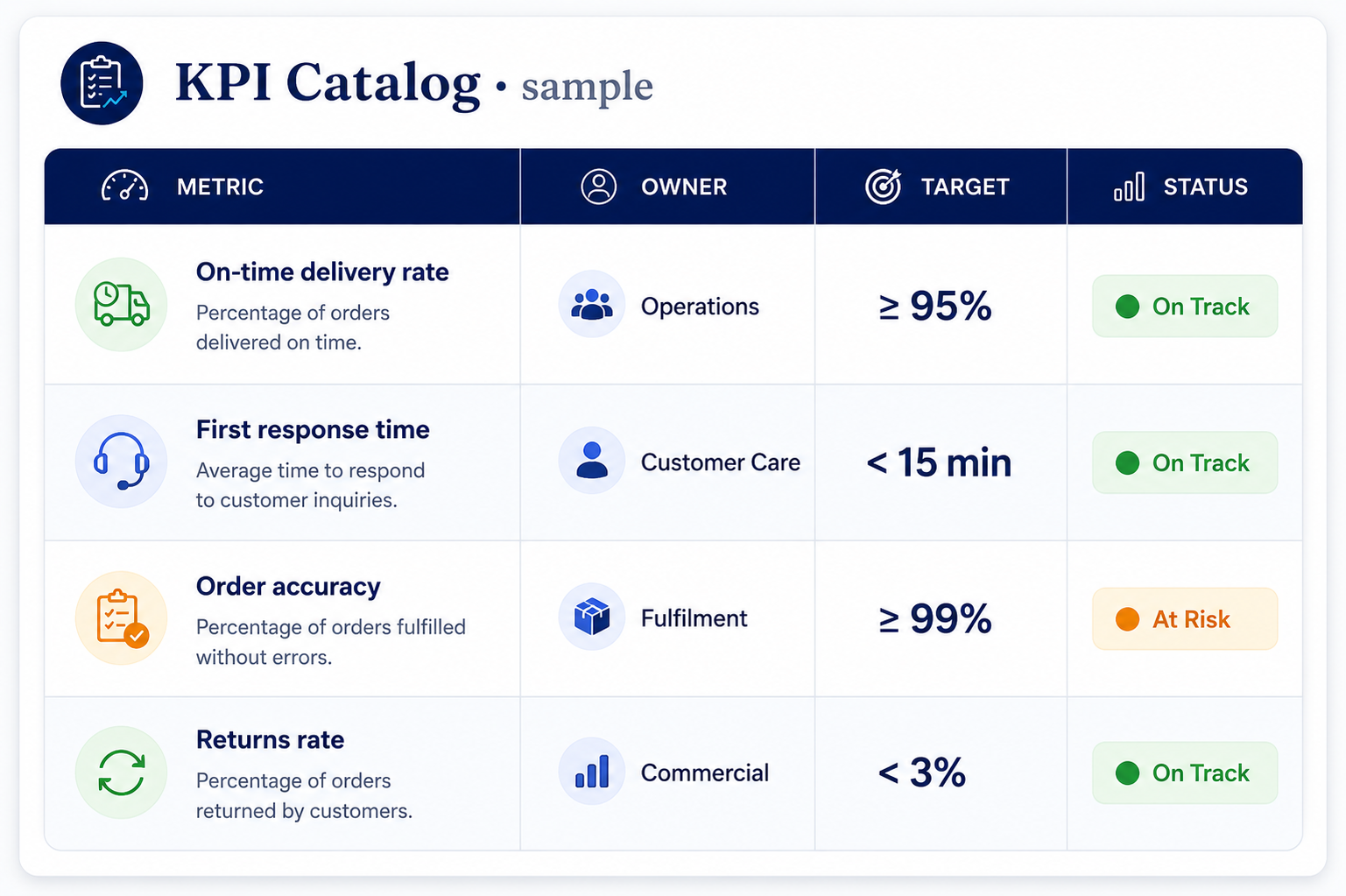
KPI Catalog sample: On-time delivery rate (Operations, ≥95%, On Track), First response time (Customer Care, <15 min, On Track), Order accuracy (Fulfilment, ≥99%, At Risk), Returns rate (Commercial, <3%, On Track)
Scenario

The situation. A logistics company's Operations, Customer Care, and Commercial teams each produce a monthly 'on-time delivery rate,' and all three numbers are different. Leadership has stopped trusting any of them.

What we do. We facilitate workshops to agree a single definition. We document the formula, the sources, and the exclusions. We rebuild the calculation once, from a governed source, and publish the result as the official figure. The KPI catalog entry becomes the reference everyone points to.

Service 02

Approved Vendor List (AVL) Management

Building the governance infrastructure that controls who supplies your projects.

AVL Management is the discipline of designing, establishing, and operating the governance infrastructure that controls which vendors and manufacturers supply your projects. The AVL is one of the most operationally consequential assets a project-driven or asset-intensive organisation can maintain — it accelerates procurement, enforces quality standards, reduces supply chain risk, and provides a defensible audit trail.

We serve three distinct client situations: establishing an AVL from scratch for organisations that have never had a controlled one; optimising or re-engineering an existing AVL that has drifted or lost credibility; and developing the governance layer that keeps the AVL a controlled asset long after our engagement ends. Our senior practitioners have built AVL departments inside complex EPC and industrial environments and sat in the procurement and QA roles that use these systems daily.

  • Approved vendors skip re-qualification at every new project — procurement moves faster.
  • Quality standards enforced at entry — not after a defective product reaches site.
  • A defensible audit trail — the governance record that protects the organisation.
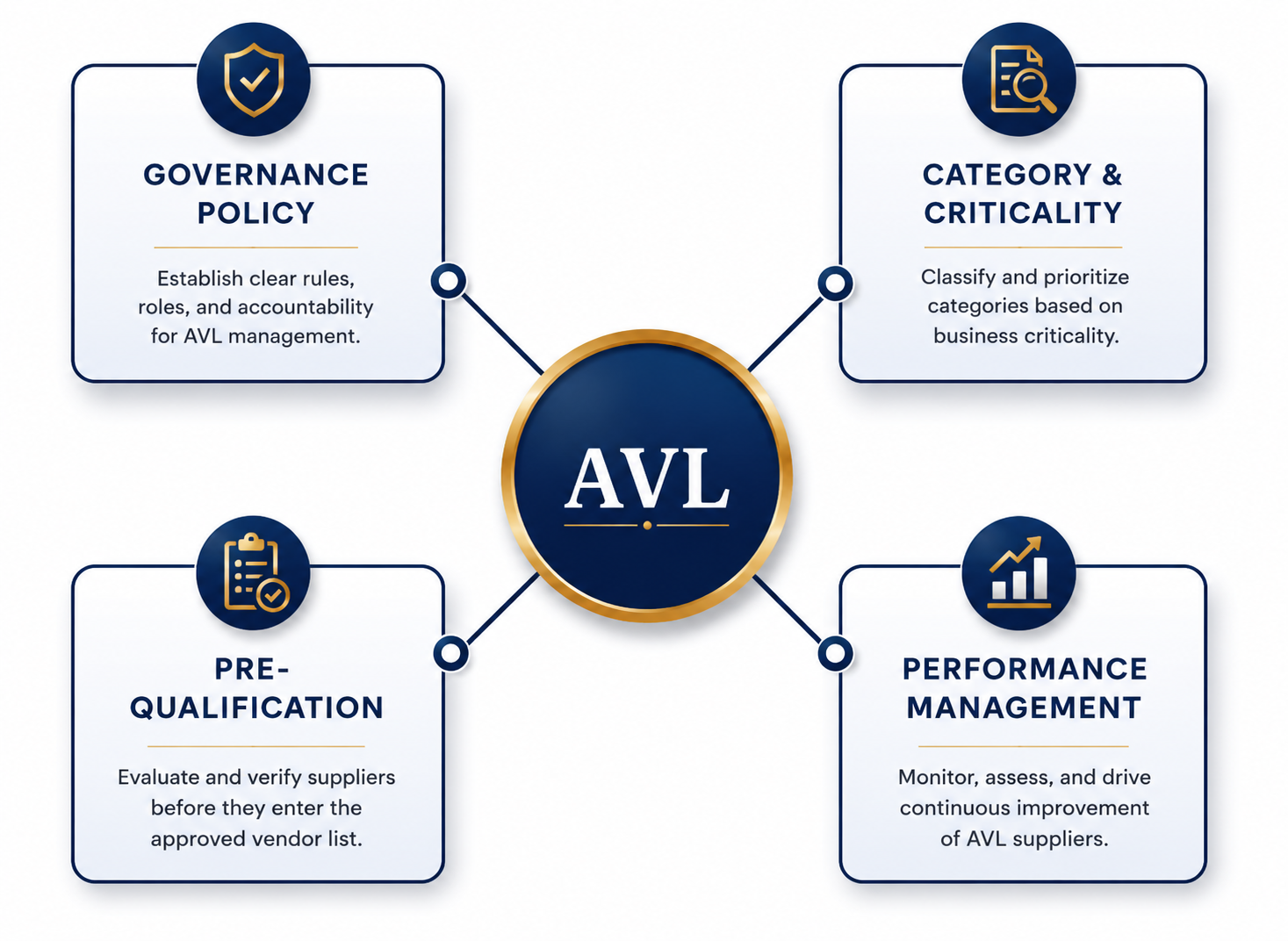
AVL governance framework: Governance Policy, Category & Criticality, Pre-Qualification, Performance Management
Scenario

The situation. An owner-operator has had an AVL for years, but procurement teams routinely bypass it, quality issues are recurring, and no one trusts the current vendor status data. Attempts to enforce the AVL from the top have failed because the AVL itself is not fit for purpose.

What we do. We diagnose why the AVL isn't working — usually a combination of category taxonomy that no longer matches how procurement thinks, pre-qualification criteria too heavy for low-risk categories, and a deviation process too slow to use in practice. We redesign the parts that are broken, migrate carefully to the new model, and re-establish trust.

Service 03

Business Intelligence & Dashboards

Putting the right number in front of the right person at the right time.

Business Intelligence & Dashboards is the discipline of presenting information in a way that drives decisions. Where reporting tells you what happened, BI shows you why, what's changing, and where to look next. We design interactive dashboards — executive cockpits, operational consoles, and 360-degree views — that turn a clean data foundation into a tool people actually use.

A dashboard is not just a chart on a screen. A good dashboard is a designed product: it knows who its user is, what decisions that user makes, and what information helps them make those decisions faster and more accurately. Our work starts with the user, not the data. We interview the people who will use the dashboard, understand what they need to decide, and design backwards from there.

Also within this practice: bespoke web application development, and user training & dashboard governance.

  • Designed for decisions, not for display — every tile maps to a choice someone has to make.
  • Starts with the user, not the data — we interview before we build.
  • The morning email compilation disappears — what took six emails now takes two minutes.
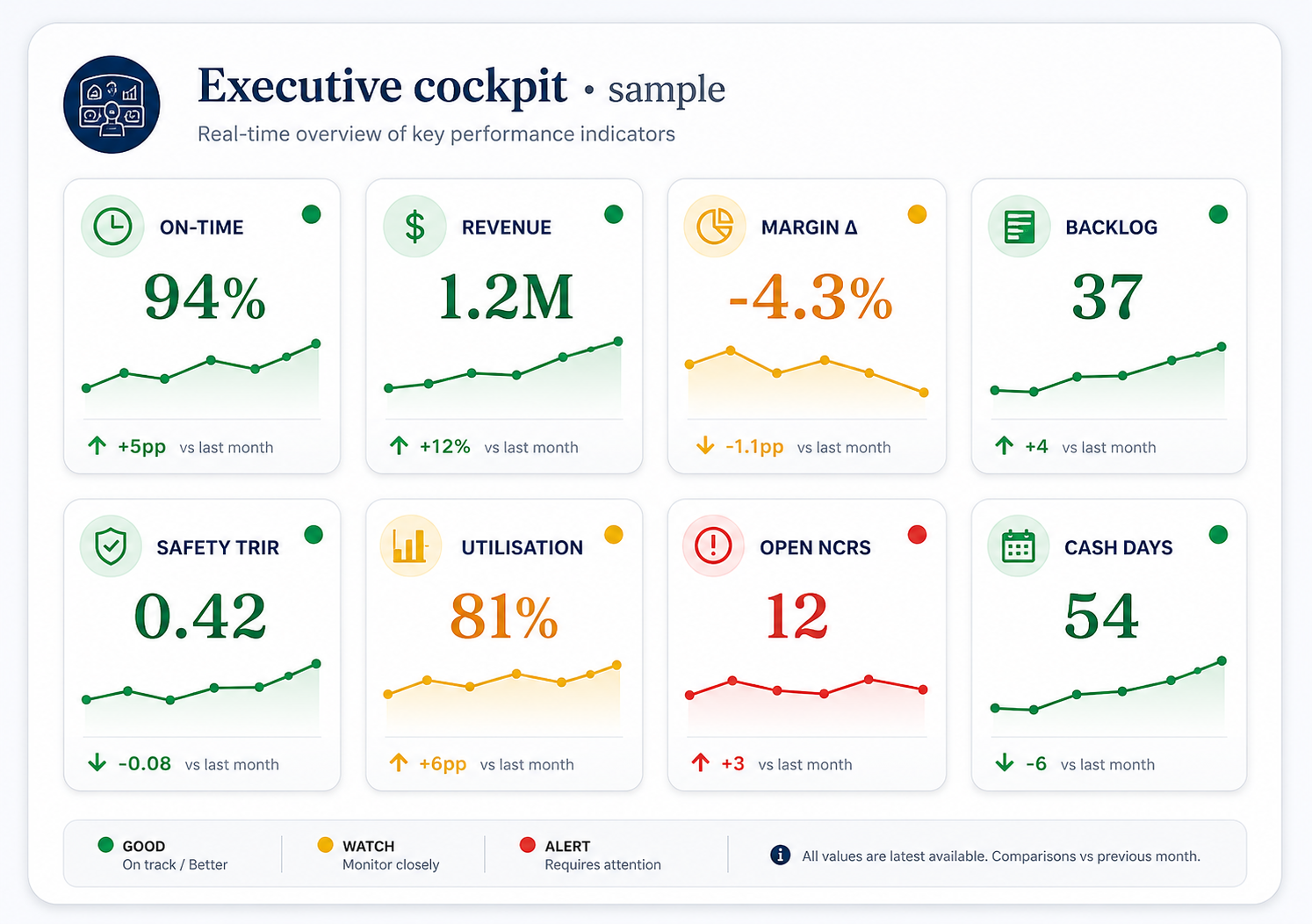
Executive cockpit sample dashboard showing 8 KPI tiles: On-time 94%, Revenue 1.2M, Margin Delta -4.3%, Backlog 37, Safety TRIR 0.42, Utilisation 81%, Open NCRs 12, Cash Days 54
Scenario

The situation. A CEO wants a single screen, opened first thing every morning, that tells her how the business performed yesterday across the seven metrics that matter most. Today she relies on her assistant compiling figures by email from six department heads.

What we do. We design an executive cockpit refreshed overnight. Seven tiles, each with the metric, target, status indicator, and 30-day trend line. One click drills into detail. The compilation work disappears; the morning routine takes two minutes.
Serious engineering environments produce serious data. Our job is to make sure the decisions built on that data are just as serious. — From our engagement notes
Service 04

Process Mapping, Optimization & Re-engineering

Make the invisible visible. Then make it work better.

Process Mapping is the discipline of understanding how work actually flows through an organisation, finding the friction in those flows, and redesigning them to work better. We document current-state processes, identify bottlenecks and waste, and design future-state processes. Implementation of the redesigned process — including any technology change — remains with the client's team or their chosen partner.

Every organisation has processes — sequences of steps that turn an input into an output. Most were never designed; they grew, organically, in response to immediate problems. Over time they accumulate workarounds, redundant approvals, manual reconciliations, and steps whose original purpose no one remembers. Our work starts by making the invisible visible.

  • Finds the waits, not just the steps — nine days of cycle time often hides six approval queues.
  • Makes the invisible visible — most broken processes were never designed; they just accumulated.
  • Delivers the redesign; implementation stays with you — a blueprint, not a dependency.
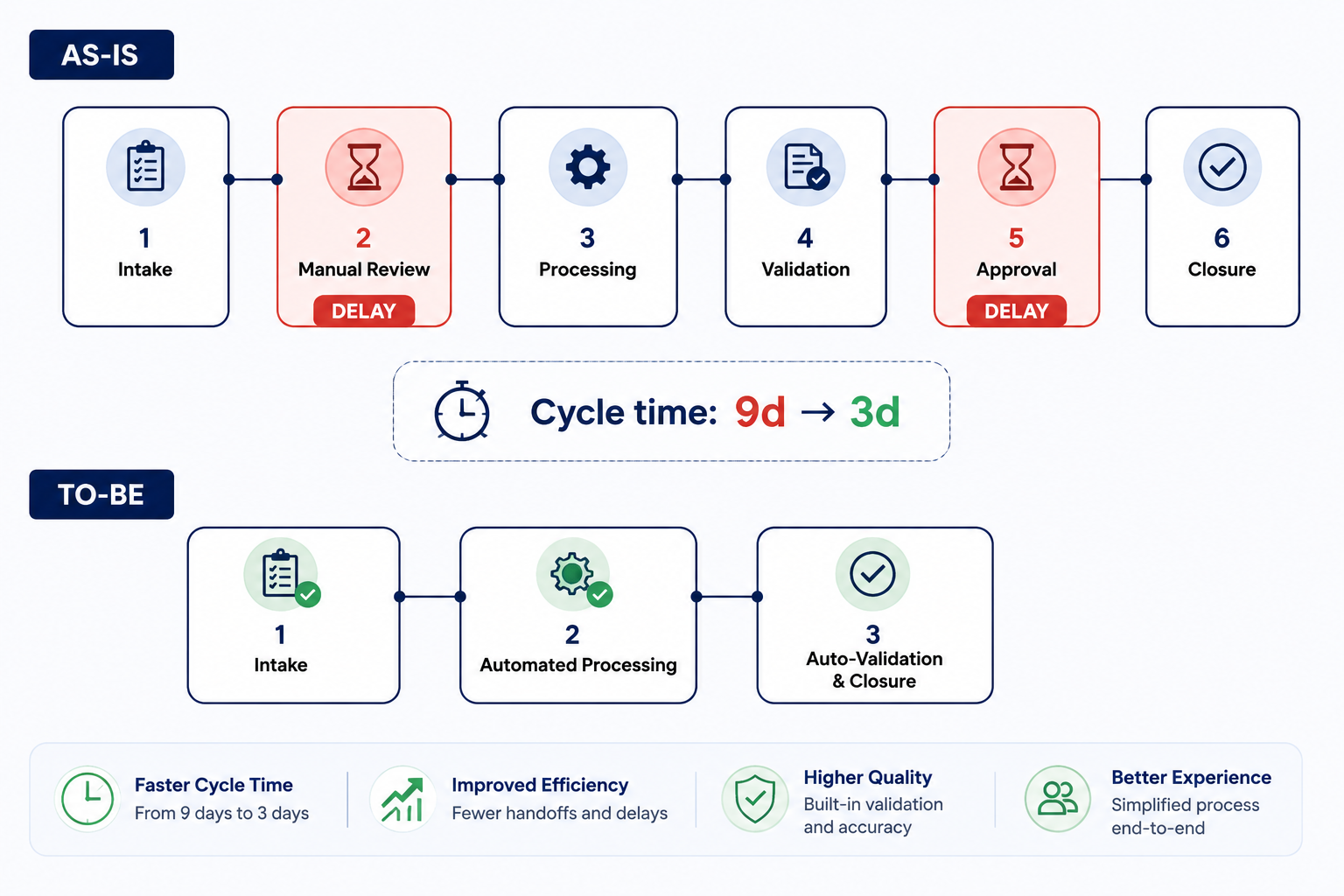
As-is versus to-be process flow: 6-step as-is process with delays at Manual Review and Approval (cycle time 9 days) redesigned to a 3-step to-be process (cycle time 3 days)
Scenario

The situation. A customer onboarding process officially takes three days; in practice it takes nine. Leadership asks for an explanation. Nobody can give a clear one — each step seems reasonable in isolation.

What we do. We map the actual process, end to end, by shadowing the people who do it and reviewing actual case durations. We find six places where work waits for approvals, three duplicate data entries, and a handover that happens by email and frequently gets lost. The redesigned process moves the average from nine days back to three.

Service 05

AI-Powered & Intelligent Systems

Using AI to detect, retrieve, and assist.

AI-Powered & Intelligent Systems is the discipline of applying modern AI techniques to business problems where the useful work is at a scale humans cannot handle unaided. We build AI-augmented dashboards that surface anomalies and draft narratives, intelligent document and knowledge systems that turn unstructured records into a queryable knowledge base, and operational intelligence platforms that detect patterns in the ongoing flow of operations.

Most organisations have far more data than they actively use, and far more documents, cases, and interactions than they can review. This is where AI techniques earn their place — as an attention amplifier, surfacing the cases, signals, and questions that deserve a human's time. In every case, the system amplifies human judgment; it does not replace it.

  • Turns thirty thousand documents into a queryable knowledge base — discovery in minutes, not hours.
  • Surfaces anomalies and patterns at a scale no team can match manually.
  • An attention amplifier, not a replacement — every signal still ends with a human decision.
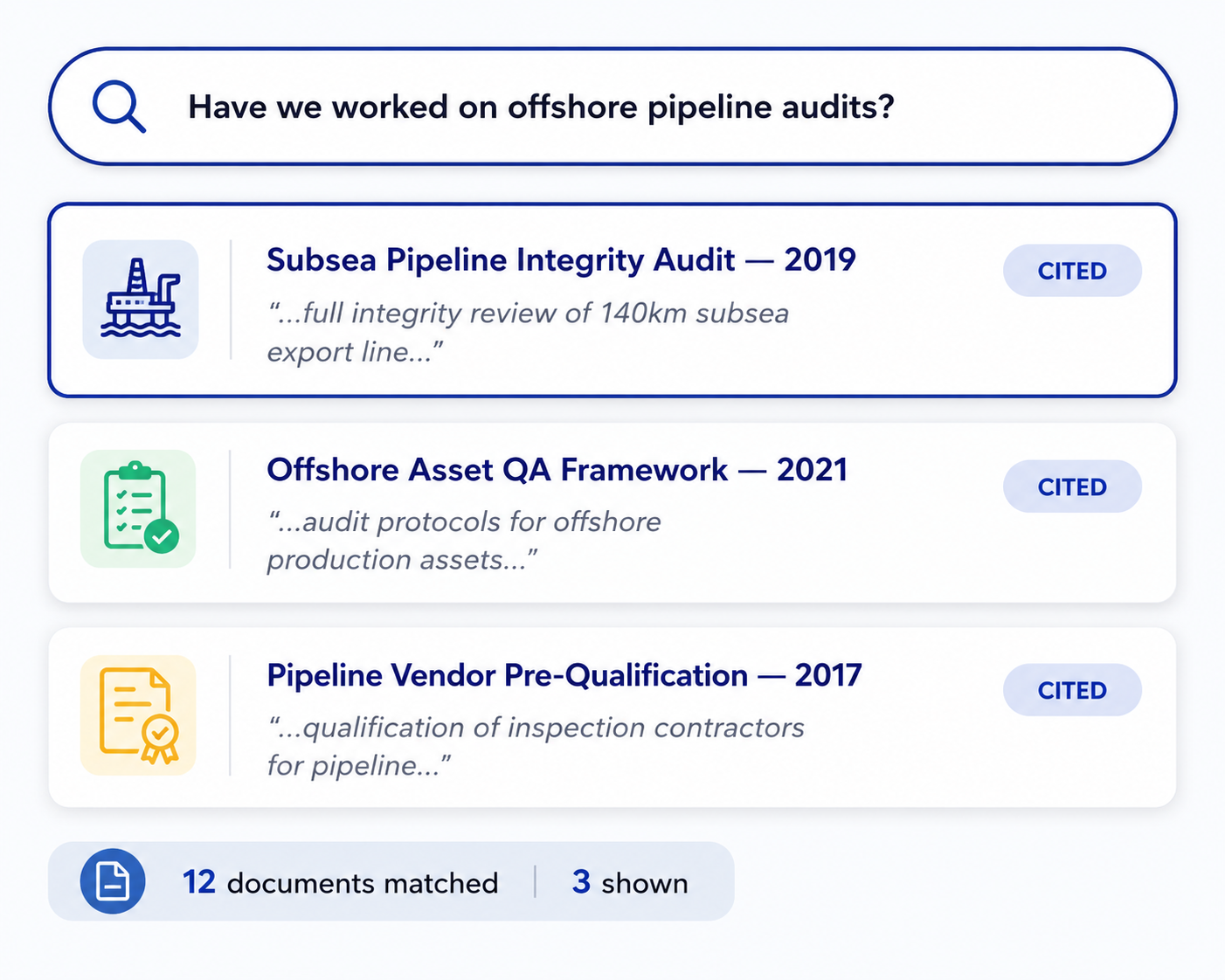
Intelligent document search: query 'Have we worked on offshore pipeline audits?' returning 3 cited results from 12 matched documents
Scenario

The situation. A professional services firm has thirty thousand client engagement documents accumulated over a decade. Senior staff know the answers to most prospect questions are somewhere in there, but no one can find them in a reasonable time.

What we do. We build a semantic search and retrieval-augmented generation system over the document corpus. A staff member can now ask 'have we ever worked on a problem like X in industry Y' and get a short, cited answer drawn from the actual documents. Discovery time drops from hours to minutes.


What we don't do

Outside our practice:

  • Financial accounting, data-warehouse implementation, ETL pipeline development.
  • ERP implementation, workflow automation, procurement outsourcing.
  • Data warehousing, cosmetic dashboard makeovers.
  • Process implementation, workflow automation, change-management delivery.
  • Statistical forecasting, predictive modelling of future values, generic AI strategy consulting.
How we think

Three positions we hold

Short pieces on how we work, and why. Written for prospects deciding whether GTI is the right fit.

01

The senior-led model, in practice

Most consultancies describe themselves as senior-led. What we mean is more specific: the practitioner you meet at scoping is the same practitioner who delivers. Not 'senior oversight.' Not 'partner-led with junior execution.' The same senior person, in the room, from first conversation to final handover.

That model shapes what we can and cannot do. We do not staff fifty-person engagements across ten workstreams — we don't work that way. What we do is bring twenty to thirty years of hands-on experience to bear on the questions that most benefit from senior judgment: how to define a defensible metric, how to design an AVL that survives audit, how to sequence a process redesign that will not collapse in implementation.

02

What a defensible AVL looks like

Every AVL that fails, fails in one of three familiar ways. The category taxonomy drifts from how procurement actually thinks about materials. The pre-qualification criteria become uniformly heavy — too much friction for low-risk categories, so teams start to bypass them. And the deviation process is either so slow it is ignored, or so lax it becomes the norm.

A defensible AVL is not just a list. It is a governance system: a taxonomy aligned with SAP and engineering disciplines; pre-qualification calibrated to material criticality; a deviation process fast enough to be used and traceable enough to be audited; a performance framework that actually removes poor performers; and a named owner accountable at the quarterly review. The parts most firms skip are the parts that make an AVL work.

03

Two things called 'AI'

When a prospect asks whether we do AI, they usually mean one of two things — and the answers are different. If they mean 'do you build AI systems as a service,' yes, in a defined form: AI-augmented dashboards, intelligent document systems, operational pattern detection. Real engineering work delivered by senior specialists. That is a deliverable.

If they mean 'do you use AI in how you work,' also yes. Across every engagement we use modern AI tools to accelerate exploration, drafting, and stress-testing. That is tooling, not a service line. The distinction matters because conflating the two sets up disappointment on both sides. Being precise about which AI a prospect is asking about is worth the extra minute in the conversation.

The architecture

The five services are not five independent offerings

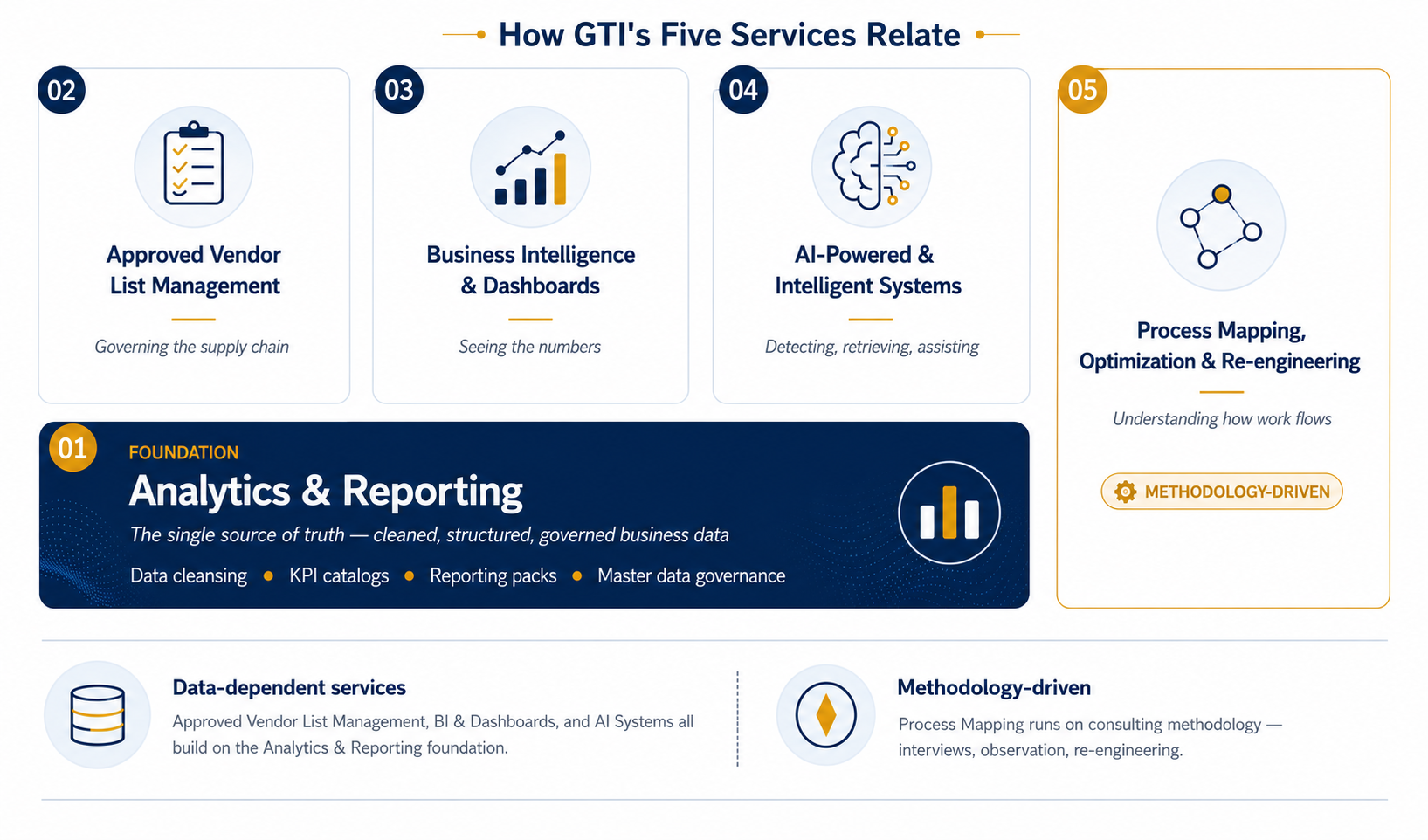
Analytics & Reporting is the foundation. BI and AI Systems build on it. Process Mapping and AVL Management are peer governance disciplines that sit alongside the data work — one governs how work flows, the other governs who supplies it.

The relationship between GTI's five services.

How we work

Senior bench, honest boundaries, disciplined delivery

We are a young firm with a senior bench. Every engagement is led by consultants with twenty to thirty years of experience — and we are honest about what falls outside our practice.

01

Senior-led delivery

The senior consultant you meet at scoping is the same consultant who delivers. There are no junior hand-offs.

02

Honest scope

Every service has a clear boundary. We are explicit about what falls outside before the engagement begins.

03

Client-owned outputs

Every deliverable is designed to be owned and operated by the client — procedures in your voice, tools your team already uses.

04

Partnered where it matters

Where a project needs deep technical implementation outside our practice, we scope it and coordinate with the client's technology partner.

On AI

Two different things — both called "AI"

There are two distinct ways AI shows up in our work, and it matters to be clear about which is which.

01 · The deliverable

AI as a service line

AI-Powered & Intelligent Systems is a defined practice: AI-powered dashboards, intelligent document and knowledge systems, and operational pattern detection. Real engineering work, delivered by senior specialists.

02 · The tooling

AI as how we work

Across every service we use modern AI tools to accelerate exploration, drafting, and stress-testing. That is how we deliver faster and sharper — the same way modern firms use cloud platforms and version control.

Where we work

Sectors we know deeply

Our practitioners come from the industries they now advise. AVL and process work is grounded in oil and gas and industrial delivery; analytics and BI translate across sectors, but our deepest experience is in the following.

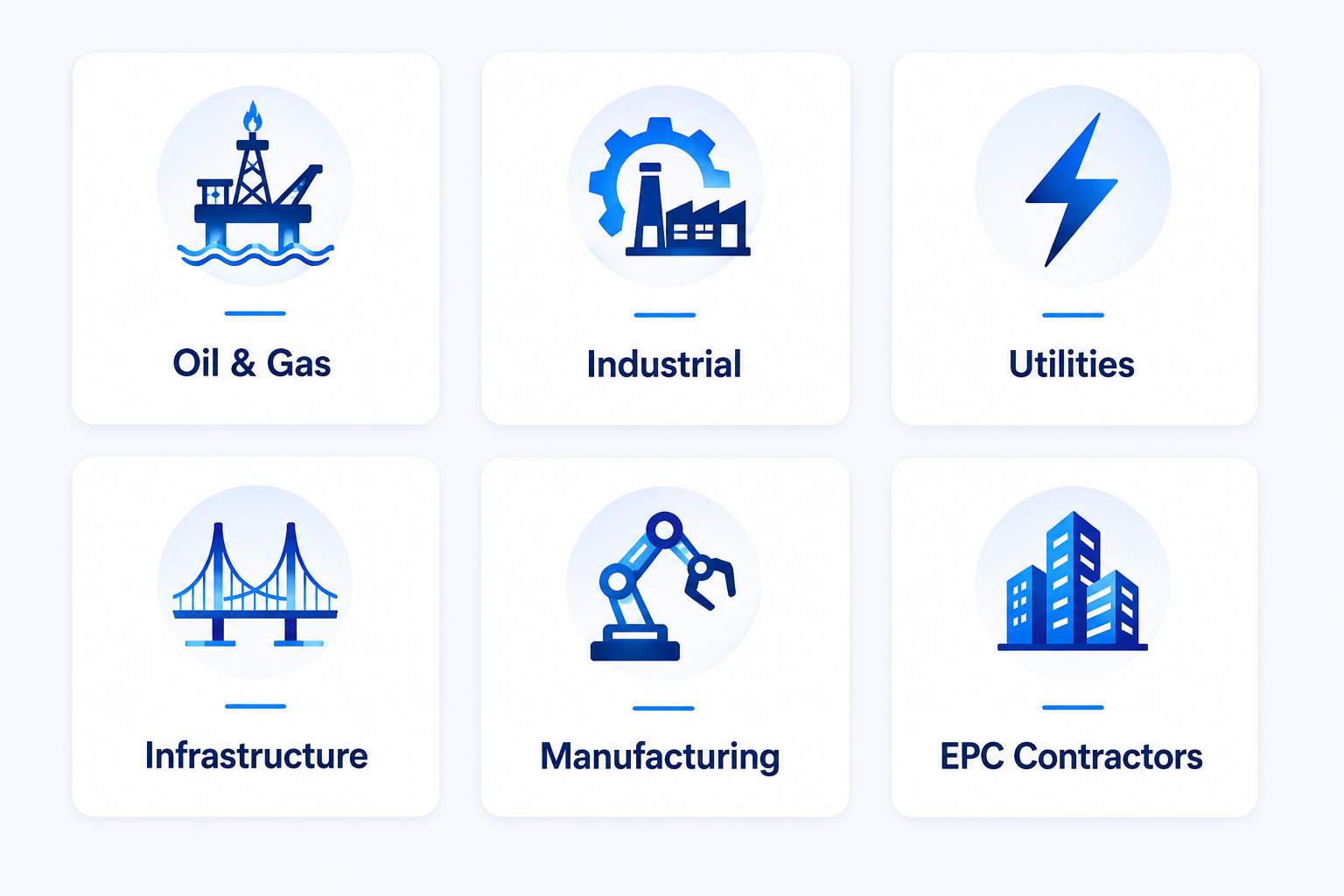
Sectors: Oil & Gas, Industrial, Utilities, Infrastructure, Manufacturing, EPC Contractors
Based in Doha

Regional presence, international bench

Headquartered in Doha, Qatar, with practitioners who have led delivery for oil and gas and industrial clients and further afield. When we work with you, the same senior consultants are in the room from scoping to handover.

Get in touch

Start a conversation

Whether you have a specific engagement in mind or want to discuss whether GTI is the right fit, we would be glad to hear from you. Every enquiry is read by a senior partner.

Office Doha, Qatar

Who reads your first message

Every enquiry is read by a senior partner before it is routed. If your enquiry is about a specific service, expect a response within two working days from the practitioner who would lead the engagement.

If your enquiry is exploratory, we will suggest a short call to understand context before proposing anything.